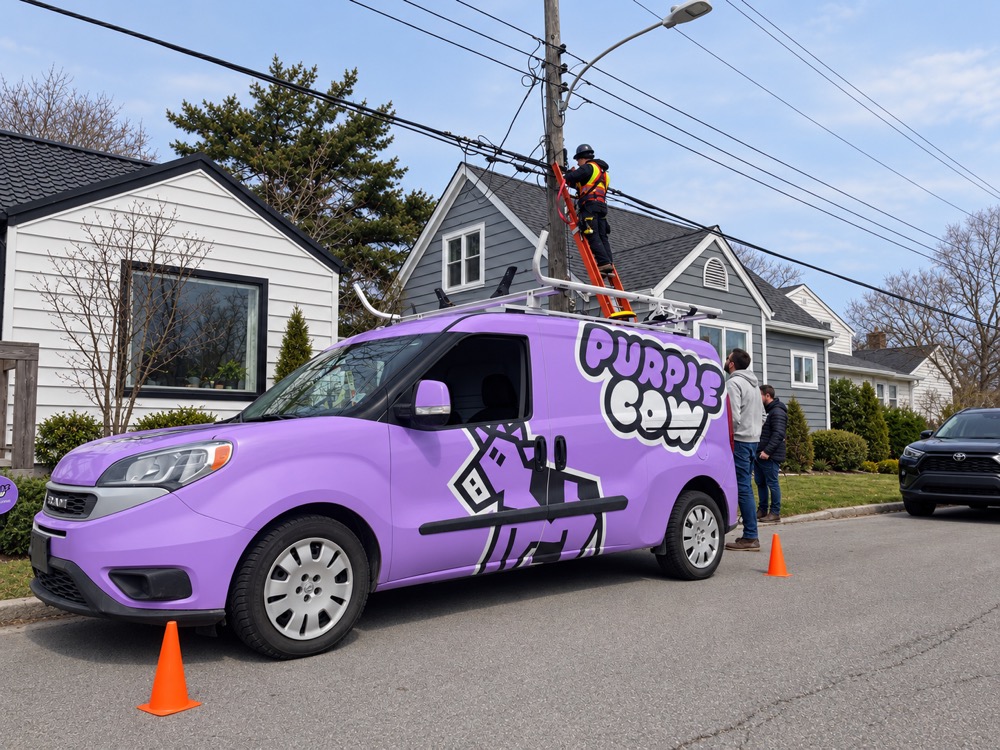
Fairview and Fairmount are now live on Purple Fibre. That's 6,000 additional homes in Halifax that can now get 2 Gbps symmetric fibre-to-the-home for $60/month, with no contract, no promo cliff, and no rate hikes. Getting here took almost three years and was a much bigger job than most people realize, so I wanted to write down what it actually took, in the honest, unglamorous version.
I get asked a lot why fibre expansion takes so long. Bell has been at it for decades. Purple Cow, as an independent, has to move differently, and every neighbourhood we add is the result of a very specific process. Here's the whole thing, start to finish, in ten steps, and then the two things after the steps that most people don't think about: why the timeline is what it is, and how a company our size actually pays for all of this.
now passed
first live customer
make it happen
The ten steps of building Purple Fibre
Send in the LiDAR car
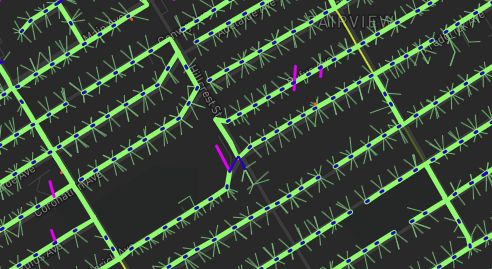
Before we draw a single line on a design, we need to know exactly where every pole, every wire, and every piece of existing infrastructure sits, down to the pixel. Twenty years ago, this would have meant weeks of people walking the streets with clipboards. We use a LiDAR car instead: a vehicle mounted with laser scanners that drives every street in the target area and captures a 3D point cloud of everything it sees. Poles, wires, trees, streetlights, building heights, road elevation — all mapped precisely.
It's genuinely futuristic to watch. And the output is what everything downstream is built on.
Count what's actually on every street
On top of the LiDAR data, we also need to know what's at every address. How many single-family homes. How many duplexes. How many units are in each apartment building. You'd think this part would be easy: just pull it from the Civic Address Finder, or Canada Post, or Google Maps. We tried. None of them are accurate enough when you're building your own network. Every one of those sources has missing addresses, wrong unit counts, or data that hasn't been updated in years.
When you're putting fibre in the air that's supposed to serve a neighbourhood for the next 30 years, "close enough" isn't good enough. A triplex that shows up in Canada Post as a single-family home is three households we designed for wrong. So we do the address audit ourselves, block by block, and we build the design off numbers we've verified with our own eyes.
Design the network to every single home
Now the actual engineering starts. Every home in Fairview and Fairmount had to be accounted for in the design. Not "most" homes. Every one. The design specifies where the fibre runs, where each splice point sits, how the signal is split for individual homes, and how each apartment building gets served internally.
A big part of this stage is deciding where to put our LCPs, or Local Convergence Points. Those are the neighbourhood-level hubs. Fibre runs from our data centre out to an LCP, and from that LCP it splits off to every home in the surrounding area. Where you put an LCP determines how efficient the network is, how easy future expansions will be, and how quickly a technician can restore service if something goes wrong.
LCP siting is also its own permitting process with the city. You can't just drop a hub anywhere you want. There are rules about setbacks, sightlines, right-of-way, and utility clearance, and every site has to be approved before it can be built.
Design for 30 years, not for today
This is the part that people don't usually see. We're not designing for the speeds households need today. We're designing for what people are going to need in 10, 20, and 30 years, and we're doing it so that we don't have to come back and rebuild the whole network when the next generation of usage arrives. Purple Fibre runs on XGSPON, which is the current next-generation fibre standard, and it's built with capacity headroom that our grandchildren will still be using. If we're going to disrupt every street once, we're going to do it right.
Submit a "make-ready" to Nova Scotia Power
Every telephone pole in Nova Scotia is owned or shared by Nova Scotia Power. Before we can hang our fibre on those poles, we have to submit what's called a make-ready. That's a formal request that says: here are all the streets we want to build on, here are the specific poles we want to attach to, here's what we need each pole to do. Then we wait for Nova Scotia Power to walk it themselves.
Nova Scotia Power scopes every single pole
They send an inspector out to physically check every pole on our request. When you look at a telephone pole, there are basically three zones. The top is power, which is high-voltage and off-limits to us. The bottom is the ground zone. In between is the communications section, which is where cable, telephone, and fibre lines live. Our fibre goes in that middle zone.
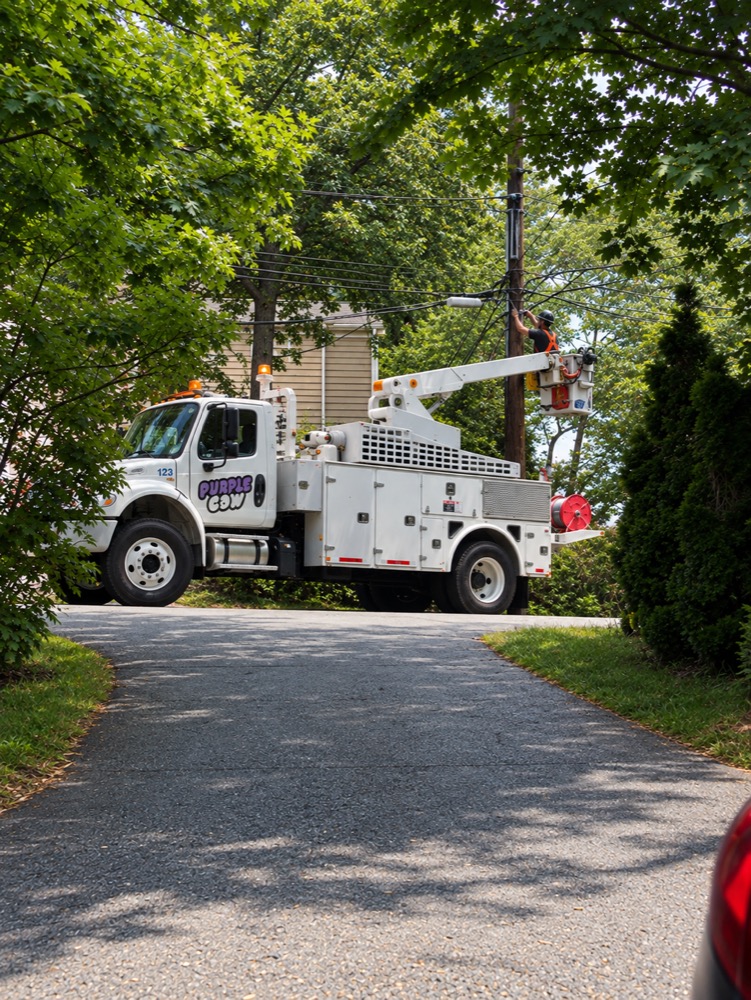
The inspector documents whether trees need to be trimmed for clearance, whether the pole itself needs to be reinforced or replaced, whether any of the existing wires need to be rearranged to make room, and whether the pole is even tall enough for another attachment. Some poles are ready to go. Some need a whole day of work before we can touch them.
Approve the make-ready and wait for the upgrades
Nova Scotia Power comes back with a list of everything that needs to be done and a cost estimate. We approve it, and then we wait. Their crews handle the actual upgrades themselves. Trimming, replacing poles, moving existing wires, all the physical prep work. This part typically takes about a year. That's not a delay we can shortcut. It's the physical reality of upgrading utility infrastructure across an entire neighbourhood.
Fun side effect: we basically had every tree in Fairview and Fairmount trimmed as part of this process. Next time a hurricane rolls through Nova Scotia and your neighbourhood keeps the lights on, you're welcome. That was us. Sort of.
Order the equipment and hope the price holds
While the make-ready work is happening, we're ordering all the physical materials in parallel. Reels of fibre-optic cable. Terminal boxes. Splice enclosures. ONTs (the little box that gets installed inside the customer's home and converts the fibre signal into an internet connection). Right now, the cost of fibre is genuinely fluctuating month to month, largely because AI data centres being built in the U.S. are consuming an enormous share of global fibre supply. That's not a Nova Scotia story, that's a global commodity market story. It affects our budgets, and it affects the timing of when we can build the next neighbourhood.
Get city approval and bring in the crew
Once the poles are ready and the materials are on hand, we make sure we have all the necessary approvals from Halifax Regional Municipality to do the work on public streets. Then we bring in our subcontractor, a specialized crew that actually strings the fibre from pole to pole, runs the drop lines to individual homes, and installs the equipment cabinets on the ground.
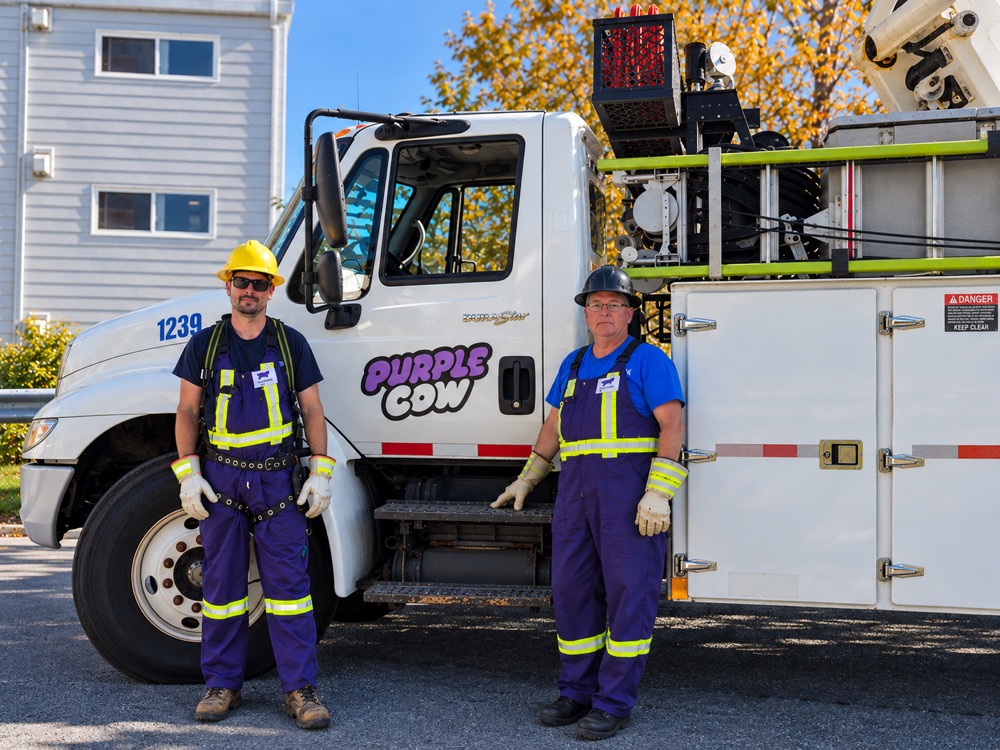
These people are, honestly, superheroes. They show up in every kind of weather with the same can-do attitude, they believe in what Purple Cow is trying to do for Nova Scotia, and they treat every pole and every drop like it's their own network. This whole thing does not work without them.
Splice, test, and turn it on
Once everything is physically installed, every single fibre connection has to be spliced by hand. A splicer takes two hair-thin fibre strands and fuses them together so that light passes through cleanly. Every splice gets tested. Every drop to every home gets tested. Every terminal cabinet gets tested. If any of it isn't right, we find it here, not after a customer signs up.
And then, at the end of all of that, the neighbourhood goes live. That's when we celebrate. Dance party in the office. High-fives all around. Somebody usually cracks something open to toast the crew. Three years of work turning into 6,000 homes going live at once is a moment that never gets old.
Why this took almost three years
People are often surprised to hear that a 6,000-home fibre build took three years. Half of that time was actual construction. The rest was waiting.
The single biggest reason a fibre build in Nova Scotia takes as long as it does is the make-ready process with Nova Scotia Power. Compared to utility companies in other Canadian jurisdictions, the timelines here are noticeably longer. In some provinces, the equivalent make-ready work happens in a matter of months. In Nova Scotia, we plan for roughly a year for the make-ready alone, and sometimes it runs longer. That's not a knock on Nova Scotia Power. Their crews are doing physical work on utility infrastructure, and it has to be done right. But it does mean that any independent trying to build a fibre network here is starting from a longer runway than a competitor building in a jurisdiction with faster make-ready timelines.
The rest of the timeline is a combination of things: design and engineering, city approvals, coordinating our subcontractor with material availability, and the fact that the last mile of a fibre network is genuinely done pole by pole, splice by splice, home by home. There's no way to parallelize a lot of it. If it's a bad winter or a wet spring, we lose weeks. If a specific street has trees that need to be trimmed before we can hang fibre, that street waits until the trimming is done. Every neighbourhood has its own version of this.
The short version: fibre expansion isn't slow because we're not trying. It's slow because the underlying process is slow, and we don't cut corners on any of it.
How we actually pay for all of this
This is the part that almost never gets talked about in telecom.
Fairview and Fairmount cost us roughly $6 million to build. That's about $1,000 per home passed, and it's the actual dollar figure of what it takes to run fibre-optic cable past 6,000 Halifax homes and get them ready to be connected. That number doesn't include any of the ongoing cost of running the network once it's live.
Purple Cow is not a subsidiary of a national telecom. We don't have BCE's balance sheet or private equity behind us. We're an independent Nova Scotia-based company, and every dollar we spend building Purple Fibre has to come from somewhere real. Overwhelmingly, that "somewhere" is two places: bank loans and our own operating cash flow.
What that means in practice: every customer who signs up for Purple Cow or Purple Fibre is directly funding the next neighbourhood we build. That's not a marketing line. It's the mechanical reality of how a company our size expands. We take the revenue from existing customers, we pay our team and our operating costs, and we put what's left into the next section of the network. When the network gets bigger, our cash flow gets bigger, and we can afford to build faster. When the herd grows, the herd builds itself.
That's also why our pricing is what it is. We're not running a promo-price-then-jump model because we don't need to. Our economics only work if customers stay. Every household on flat, honest pricing is a household we can count on to keep funding the build.
What surprised me most
Honestly, the thing that still blows my mind is how long the work actually takes. When we started, I thought Fairview and Fairmount would take about twelve months. It took three times that.
Part of it is the make-ready timeline, which I already talked about. But the bigger surprise for me was how little of this work can actually happen in parallel. You can't design the network until you have the field data. You can't submit the make-ready until you have the design. You can't build until the make-ready is done. You can't splice until the build is done. You can't turn homes on until the splicing is tested. Each step waits on the one before it, and there's no clever project-management trick that gets around that.
I've built a lot of things in this company, but the physical work of putting fibre in the air is on a completely different clock than anything else we do. Software you can iterate on in a week. A neighbourhood of fibre, you get one shot at, and it takes three years to know if you got it right.
What's next
Fairview and Fairmount are two more steps toward what we set out to do: build enough of our own network across the Halifax Regional Municipality that Nova Scotians finally have a real fibre alternative to the incumbents. We're not going to telegraph exactly which neighbourhoods are next, because the honest answer is that it depends on which streets Nova Scotia Power gets the make-ready work done on and how the material market moves. What I can tell you is that we're building continuously, and we're not slowing down.
If you live in Fairview or Fairmount, your address checker on our site will tell you right now whether Purple Fibre is at your specific address. If you're in a nearby neighbourhood, keep an eye on it. We add addresses as they light up.
A thank you
To the crews that spent months in Fairview and Fairmount, in every kind of weather, hanging fibre one pole at a time: thank you. Three years of work went into these 6,000 homes, and it wouldn't have happened without you.
And to every Purple Cow customer paying $60 a month right now for 100 Mbps of cable, or 2 Gbps of Purple Fibre: you're the reason we can afford to build the next neighbourhood. Every household on the herd is a vote for a different kind of telecom in Atlantic Canada. We take that seriously.
See if Purple Fibre
is at Your Address
2 Gbps symmetric fibre for $60/month, flat, no contract. Check in about 10 seconds.
Check My Address →