I've been running Purple Cow for a while now, and I can't remember a stretch where the way I work changed as much as it has in the last year. Most of that comes down to two tools: Claude, an AI from Anthropic, and Wispr Flow. I wanted to write down what's actually different, because it isn't what I expected.
(up from 3–4)
licences
Cow University
I have a coach that keeps me out of the weeds
The easiest trap for any CEO is getting pulled into the weeds. A customer issue here, a vendor email there, and suddenly a whole week is gone and none of the big stuff moved.
So I set up an AI that looks at my email, my Slack messages and my calendar, and scores me on how I'm doing as a CEO. It tells me when I've spent too much of my week firefighting and not enough on the things only I can do.
Here's my report card from the first week:
A D. Just barely above passing.
Part of that is that on the inside, we're still a startup. A lot of people here wear many hats, and I'm one of them. I still love jumping in to solve a customer's issue and help someone out, and I don't want to lose that completely. But every hour I spend in the weeds is an hour I'm not spending on the big picture: where the company is going, and the new roles we can create for people on our team as we grow.
Getting a report card from software is humbling, but it works. I'm more aware of where my time actually goes than I've ever been, and it's helping me hand off more of the work I've been holding onto.
I don't type anymore
This one sounds small, but it might be the biggest day-to-day change. I use Wispr Flow, which turns what I say into text anywhere on my computer. Emails, Slack, documents, prompts to Claude, all of it. I talk, and it writes.
Talking is so much faster than typing, and it's changed how much I can get through in a day. This blog post started the same way: me talking through what I wanted to say.
We can finally hear every customer conversation
Our team handles thousands of phone calls and text messages a day. Until recently, the only way to know how those conversations were going was to sample a handful and hope they were representative. Reviewing all of them by hand would take an army of people. We never could.
Now Claude is connected to our customer interactions: call transcripts, text messages and phone calls. It can go through every one of them. I can see how each rep is doing, spot patterns, give real coaching, and catch issues early, before they turn into a bad experience for a customer.
That made something possible we'd wanted for a long time: Cow University.
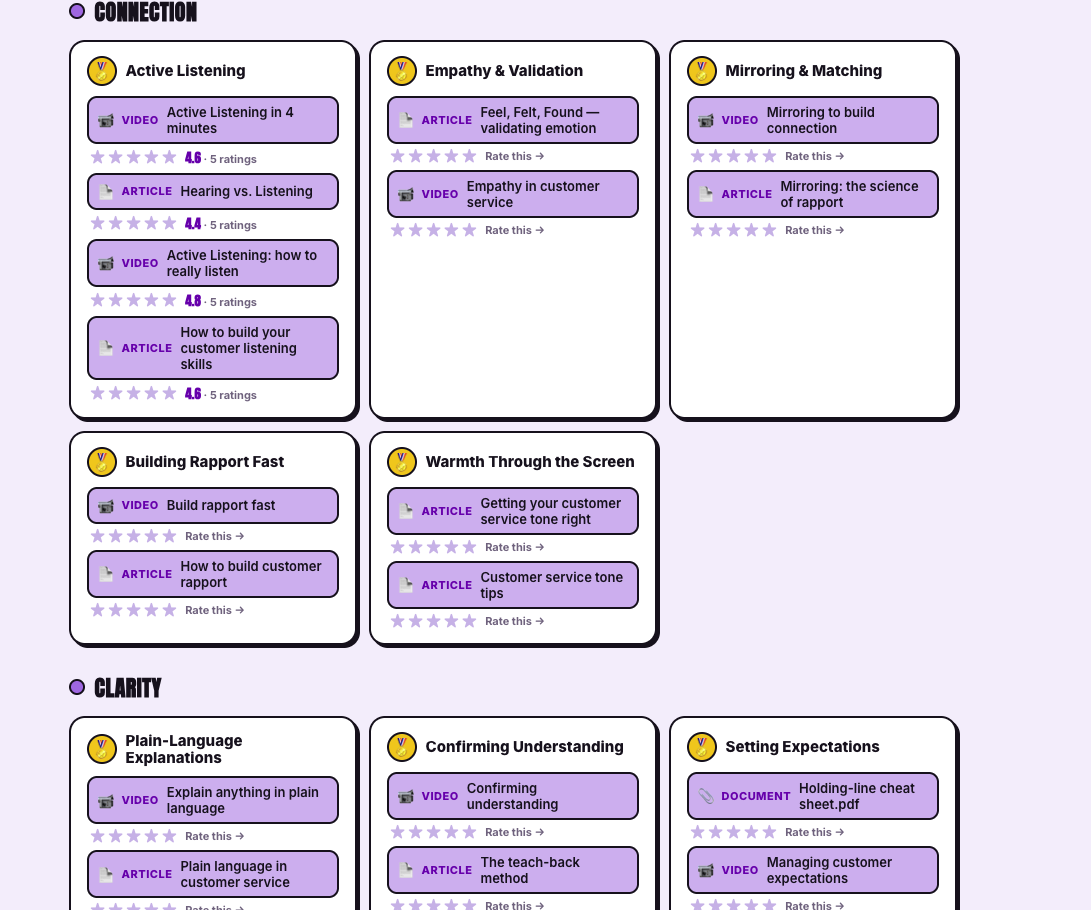
Cow University is our coaching program for the people who talk to our customers every day. There are 25 skills and badges to earn, grouped into areas like Connection (Active Listening, Empathy and Validation, Mirroring and Matching, Building Rapport Fast, Warmth Through the Screen) and Clarity (Plain-Language Explanations, Confirming Understanding, Setting Expectations). Each badge comes with short videos and articles, and the team rates them so the best material rises to the top.
What makes it work is the coaching. Every rep gets ongoing feedback from AI based on their real calls and texts. It's not a once-a-year review. It's feedback on the conversation you had this morning, so you can be better on the next one. The goal is simple: every customer who calls or texts us should have a great experience, and every rep should have a clear path to getting better at their job.
A website that finally feels like us
Here's a confession: every previous version of our website was designed by me. I used Canva, Figma and any other tool I could get my hands on. I was never very good at it. I just knew nobody else on the team was either, so I took it on.
We also spent a lot of time putting together our brand guide: the colours, the voice, the personality of the herd. But the website never quite matched it. This time, we used Claude to help rebuild it, and for the first time, the website feels like Purple Cow. I love it. It looks and sounds like us, and it's far better than anything I ever made myself.
The biggest change: my leadership team
Here's the one I didn't see coming.
It used to be that when someone on our senior leadership team needed something (a report, a data pull, a change to a page or a tool) they'd open a ticket and wait for our dev team to get to it. That's how most companies work. The dev team becomes the bottleneck for everyone.
That's not how we work anymore. Our leaders now go get the data themselves. They build the reports they need. They create the page, or make the change to the software, on their own. Our dev team is free to focus on the big stuff.
Leaders opened tickets and waited. We shipped 3 or 4 big projects a quarter.
Leaders build what they need themselves. We ship 15 to 25 big projects a quarter.
That's not a small improvement. It's a different company.
I could give you dozens of examples, but here's one. Krystina on our team can now pull data she never had access to before and build her own reports to make decisions. One of those reports told us something we'd missed: customers wanted to book a setup appointment right on our website when they signed up, instead of getting a text from us afterwards. So we built it. Since then, 30% more customers book a setup appointment. That's a better start for those customers, and it came from someone on our team spotting it in the data herself.
(And if you're signing up now: yes, you can book your setup right on the website.)
Building instead of renting
Something else has started happening. Our team has been going back through the software we pay for, the subscriptions every company piles up, and rebuilding some of it ourselves.
We used to pay for 110 Salesforce licences. Today we pay for 7. That alone saves us about $100,000 a year. We've also completely replaced our meeting software and our project management software with tools we built in-house, shaped around exactly how our team works.
Every subscription we replace is money we save, and saving money is how we keep our prices where they are for our customers.
And it isn't just the dev team doing this. It's people across the company who are excited about building things with AI ("vibe coding," as people call it), fixing problems on the fly instead of waiting for someone else to.
Is AI replacing people here?
Short answer: AI has replaced a lot of tasks here, and we've moved people into new roles because of it. But it's still weak at strategy, sales and most customer conversations. When you text us, our AI helper may solve a simple question while you wait for a rep, but it's there to speed things up, not replace the person on the other end. And because we're growing, Purple Cow is hiring more people now than we ever have.
It's a big enough question that I wrote a whole post on it: Will AI replace people? The honest answer from inside Purple Cow.
What this means for you
If you're a Purple Cow customer, here's what all of this adds up to. We run more efficiently, so we can keep our prices low. Our team gets continuous training and coaching, so the person you talk to keeps getting better at helping you. And we can spend our time improving the experience of being a customer instead of waiting in a ticket queue. Better service, at a lower price. That's the whole point.
What I'm proudest of
The tools are impressive, but they aren't the part that gets me. It's watching our team step up. People who never thought of themselves as technical are building things. Problems get solved the day they show up. We're moving faster than we ever have, and the list of things we want to do keeps getting longer, in the best way.
As the leader of this company, that's the most empowering thing I've seen in a long time. I'm proud of this team. And I'm excited for what we build next.
Join the Herd
Internet built by a small team that moves fast. Check your address in about 10 seconds.
Join the Herd →